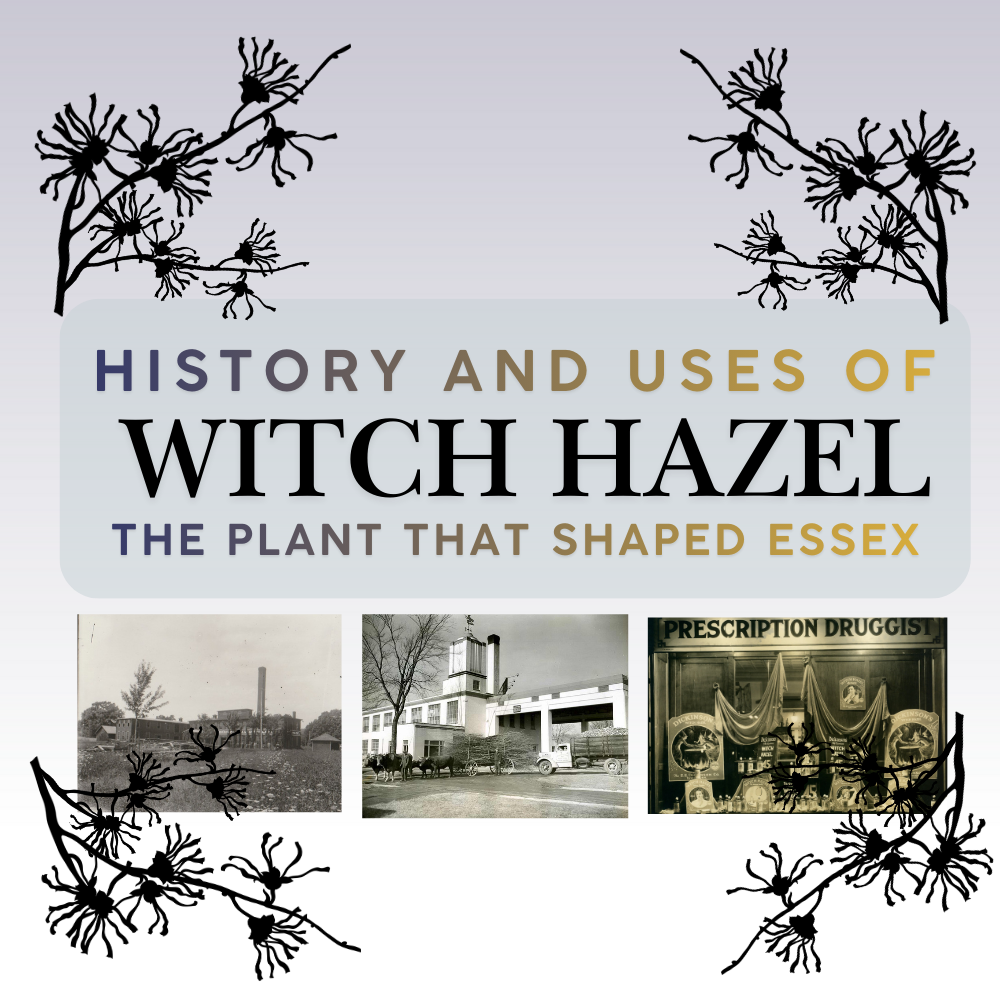
History and Uses of Witch Hazel: The Plant that Shaped Essex
Join EHS and House of the Triple Moon for a special America 250 program exploring witch hazel, a native plant that helped shape Essex. Indigenous to Connecticut, witch hazel was long used by Native communities, who developed the practice of steeping its twigs and leaves to create a mild astringent. Colonial settlers in Potapaug (now Essex) quickly adopted this remedy, and it became a household staple. Readily available and often found growing close to home, witch hazel was blended into oils, poultices, and salves and served as a trusted treatment for many everyday ailments. Although widely used, witch hazel was difficult to sell commercially due to its short shelf life—until the 1860s, when a doctor in Essex discovered that adding alcohol preserved the witch hazel extract. By 1875 innovations in the production of witch hazel distilling, made Essex the capital of the industry. For the next 100 years, E.E. Dickinson & Co transformed a local product into an international commodity—firmly securing Essex’s place in this remarkable story. Join us as we explore the history, uses, and lasting legacy of this remarkable local herb and work hands-on with a plant that continues to connect us to Essex’s past. Registration Required! Please […]
Free